Published on November 1, 2026.
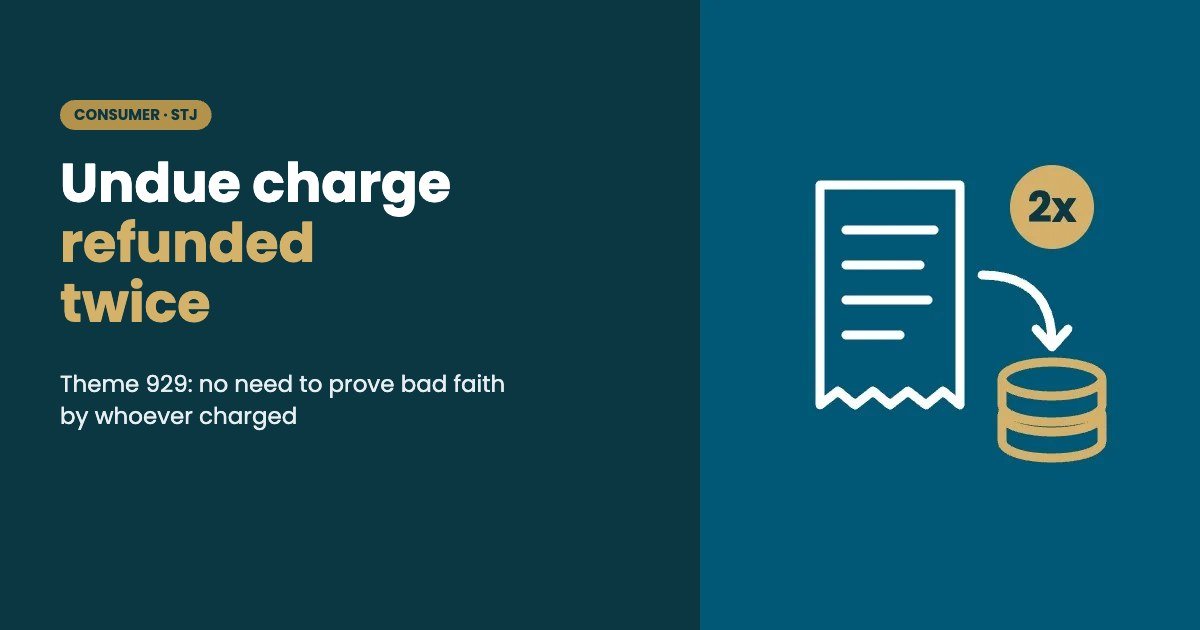
A fee you never agreed to, insurance bundled into a loan, a payroll-deduction loan you never requested, a phone bill with a service you never used. In all these cases, Brazil’s Consumer Protection Code requires the company to refund twice what was overpaid. For many years, however, companies defended themselves by arguing that the consumer had to prove bad faith. In September 2026, the Special Court of Brazil’s Superior Court of Justice (STJ) decided Repetitive Theme 929 and established the opposite view: it is enough that the charge goes against objective good faith. Here is what was decided, what still depends on the publication of the judgment and how to gather evidence.
What the law says
The sole paragraph of art. 42 of the Consumer Protection Code (Law 8.078/1990) says: “A consumer charged an undue amount is entitled to a refund equal to twice what was overpaid, plus monetary adjustment and legal interest, except in the case of justifiable error.”
Repetição do indébito is the technical name in Brazilian law for refunding what was paid but not owed. The courtroom battle has always been about the final part of the rule: what counts as a justifiable error and whether the consumer had to prove the company acted on purpose.
What the STJ decided in Theme 929
The Special Court concluded the judgment on September 15, 2026, in REsp 1.963.770/CE, reported by Justice Humberto Martins. The official theme page records the merits as decided and states that the thesis awaits publication of the judgment (accessed on November 1, 2026).
Under the thesis announced at the hearing and reported by the specialized press, the double refund:
- does not depend on the intent of the company that charged and applies when the charge goes against objective good faith;
- has as sufficient evidence the company’s silence or refusal in response to the consumer’s request;
- requires the company to prove, in its defense or at the evidence stage, that it did not act against objective good faith;
- is ruled out, as a justifiable error, when the courts were divided on that charge or when the clause used was only declared void later.
In practice, the burden of proof has switched sides. Whoever charged wrongly must explain why they acted fairly.
The prior request has become evidence
The point with the greatest practical effect is the second item of the thesis. If the consumer complained and the company ignored the request or refused the refund, that already counts as evidence for claiming double. That is why, before any lawsuit, it is advisable to record the request in a way that can be proven: customer service protocol, complaint to the ombudsman, a filing on consumidor.gov.br, email or an extrajudicial notice. Keep the protocol number, the date and the response received.
What about older charges, from before 2021?
In October 2020, the same Special Court had already waived proof of bad faith when deciding EAREsp 676.608/RS and other appeals, with the judgment published on March 30, 2021. At that time, it limited the thesis’s effect: in consumer contracts not involving public services, the rule only applied to amounts charged after publication.
According to reports of the Theme 929 hearing, the view that prevailed now is that there was no change in case law capable of justifying that time limit. If the judgment confirms this point, the double refund may also cover payments made before March 30, 2021, subject to the statute of limitations. Confirmation depends on the publication of the judgment.
Charges that often lead to refund claims
- Payroll-deduction loan installments that the retiree or public servant never took out;
- Payroll-deduction credit card (RMC) when the person wanted an ordinary loan;
- Insurance, fees and service packages added without request to a loan or bank account;
- Phone, internet and TV services charged without a contract or after cancellation;
- Electricity or water bills unrelated to actual consumption;
- Card purchases the cardholder did not make and the bank refused to reverse.
Each case depends on the documents and the contract. When the charge relies on a clause the courts themselves were debating, such as certain interest rate reviews, the company may claim a justifiable error, and the refund tends to be single, not double.
How long you have to claim
The deadline varies with the type of charge. The Consumer Protection Code provides five years for damage caused by a service failure (art. 27), and for some charges the STJ applies the Civil Code deadline, such as refunds of water and sewage fees (Summary 412). Because the count often causes disputes, the safest course is to gather receipts quickly and not put off the claim.
How to act, step by step
- Gather bank statements, bills, pay slips or the INSS credit history showing each charge.
- Collect the contract, if there is one, plus screenshots of conversations and protocol numbers.
- Ask the company for a refund through a channel that generates proof and keep the response.
- If there is no solution, consult a lawyer to calculate the amounts with adjustment and interest and assess the double refund claim and compensation for moral damages, where applicable.
SPD Advocacia handles undue charge cases throughout Brazil, with document upload through the website and updates by WhatsApp. If the deductions are on an INSS benefit, see also the article on how to recover INSS deductions.
Frequently asked questions
Do I need to prove the company acted in bad faith?
Under the thesis announced in Theme 929, no. It is enough that the charge goes against objective good faith, and it is up to the company to prove it acted fairly.
Is the thesis already in effect?
The merits were decided on September 15, 2026. The official text of the thesis and the decision on its time scope come with the publication of the judgment, which had not yet occurred on November 1, 2026. The waiver of proof of bad faith, however, had already been applied by the Special Court since the 2020 decision.
Does it apply to water, electricity and phone bills?
Yes. The 2020 thesis already covered public service contracts with no date limit, and Theme 929 deals with undue charges in consumer relationships in general.
How much can I receive?
Twice what was overpaid, with monetary adjustment and interest. The exact amount depends on the receipts and the period charged, within the statute of limitations.
Official sources
- Repetitive Theme 929 (STJ, in Portuguese) (accessed on 11/01/2026)
- Law 8.078/1990, Consumer Protection Code, arts. 27 and 42 (Planalto, in Portuguese) (accessed on 11/01/2026)
- STJ Summary 412 (in Portuguese) (accessed on 11/01/2026)
- Coverage of the judgment: STJ sets thesis on double refund of undue charges (Conjur, 09/20/2026, in Portuguese)
By Sidnei Pedro Dias, lawyer, OAB/GO 48.603, OAB/DF 68.207 and OAB/SP 501.693.
Related pages
Undue charges: refunds, double refund and moral damages.
Unrecognized loan: deductions from a benefit or salary.
RMC payroll credit card: when the loan became a card.
Credit insurance and fees: charges bundled into the contract.
Consumer law: all services in this area.