Author: Sidnei Pedro Dias

  • Eduardo Prado joins SPD and the firm now handles criminal law

    Eduardo Prado joins SPD and the firm now handles criminal law

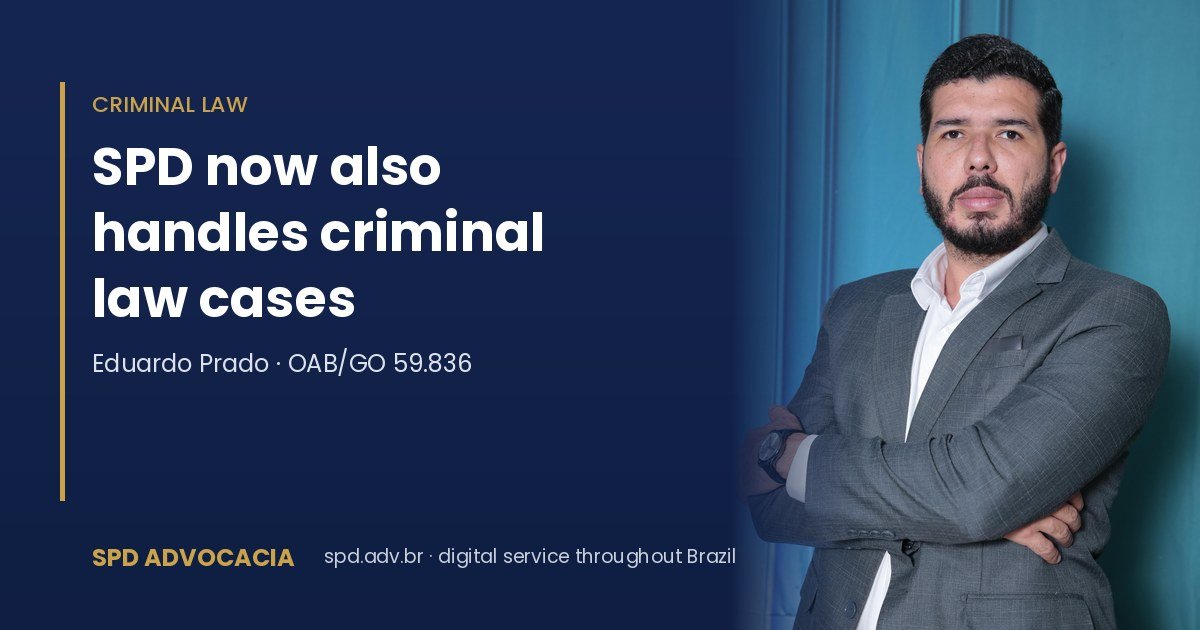
    Direct answer: SPD Advocacia now also handles criminal law. Eduardo Prado (OAB/GO 59.836), attorney, university professor and court-appointed expert, joins the firm to lead the criminal defense of individuals and companies, from the police investigation to sentence enforcement. With this new practice area, the firm becomes full service, covering civil, family and estate, corporate, tax, employment, social security and criminal law.

    Who is Eduardo Prado

    Eduardo Prado, criminal defense attorney at SPD Advocacia

    Eduardo Prado holds a law degree, graduate degrees in Criminal Law and Criminal Procedure, Administrative Law, Constitutional Law and Public Law, and is a master’s candidate in Economic Constitutional Law. Besides practicing law, he is a university professor and serves as a court-appointed expert. At the firm, he works with the team directed by attorney Sidnei Pedro Dias.

    What changes for current clients

    When a criminal matter arises in connection with a case the firm already handles, it stays with the same team. This happens, for example, with a protective order within a family case, a tax investigation against a company or an online offense that is also a crime. The history and documents already gathered stay in one place.

    Situations handled in criminal law

    • Assistance with police station statements and police inquiries;
    • arrest in the act, custody hearing, request for release and habeas corpus;
    • defense in criminal proceedings, including jury trials;
    • assessment of non-prosecution agreements, plea deals for minor offenses and conditional suspension of proceedings;
    • tax and corporate crimes;
    • protective orders and the Maria da Penha Law;
    • slander, libel and insult, with private criminal complaints for victims;
    • appeals and sentence enforcement.

    Summoned by the police or a family member arrested?

    The first step is not to give a statement without advice. The Brazilian Constitution guarantees the right to remain silent (art. 5, LXIII), and the lawyer may assist the person under investigation (Law 8,906/1994, art. 7, XXI). In case of arrest in the act, the custody hearing must take place within 24 hours (Code of Criminal Procedure, art. 310). In these situations, talk to the team on WhatsApp or fill out the form on the Criminal defense lawyer page, which gives priority to urgent cases.

    Service is provided at the office in Anápolis, Goiás, and online for clients throughout Brazil and abroad. Information is protected by attorney-client confidentiality, and each case depends on individual analysis, with no guarantee of results.

    Meet the full team on the About us page.

  • SUS denied medication or surgery: what to do

    SUS denied medication or surgery: what to do

    Brazil's Constitution states that health is everyone's right and the State's duty (art. 196). When the public health system (SUS) denies a high-cost medication, surgery or treatment, you can ask the courts to order the government to provide it. Since 2024, however, the Federal Supreme Court (STF) has set stricter rules for these requests, and knowing them makes a difference to the outcome.

    First step: apply and keep the denial

    Before going to court, you must apply to the SUS, through the high-cost pharmacy, the Health Department or the unit treating the patient. Keep the protocol number and ask for a written answer. For medications, a denial through administrative channels is one of the requirements set by the STF.

    Medication already on the SUS list

    If the drug is already on the SUS lists and the patient fits the clinical protocol for the disease, the situation is simpler: supplying it is a government obligation. Stock shortages or unjustified delays can be taken to court.

    Medication registered with Anvisa but not on the SUS list

    This is the most common situation for high-cost drugs. Under Binding Precedent 61 and STF Theme 6, a judge can only grant the request if the patient proves, all at once:

    • that the SUS denied the drug;
    • that Conitec, the body that decides what enters the SUS, acted unlawfully or is delaying its review of the drug;
    • that there is no suitable substitute on the SUS list;
    • that there is high-level scientific evidence of the drug's effectiveness;
    • that the drug is essential, supported by a well-grounded medical report;
    • that the patient cannot afford the treatment.

    In practice, the medical report is the key document. It must explain the disease, the treatments already tried, why the SUS options do not work and why that drug is necessary.

    Medication without Anvisa registration

    Under STF Theme 500, the general rule is that courts cannot order the supply of a drug without Anvisa registration, nor of an experimental drug. The exception is when Anvisa takes longer than the legal deadline to review the registration and, at the same time, the drug is registered with renowned foreign agencies and there is no registered substitute in Brazil. In those cases, the lawsuit is filed against the Federal Government.

    Who to sue and in which court

    STF Theme 1234 and Binding Precedent 60 define who is responsible, based on the annual cost of treatment, calculated at the maximum sale price to the government:

    • 210 minimum wages per year or more: Federal Courts, against the Federal Government;
    • between 7 and 210 minimum wages per year: State Courts, against the State;
    • below 7 minimum wages per year: State Courts, against the State.

    With the 2026 minimum wage (R$ 1,621.00), 210 minimum wages equal R$ 340,410.00 per year. This calculation decides where the case begins, and getting it wrong can delay the process.

    Surgeries, tests and treatments

    The 2024 binding precedents deal with medications. For surgeries, tests and other procedures, the legal basis remains the constitutional right to health. The typical case is a SUS waiting list with delays that put life at risk or worsen the disease. A medical report stating the urgency and the risk of waiting is the most important document.

    Documents to gather

    • detailed medical report, with the disease (ICD code), history, previous treatments and urgency;
    • prescription or medical order for the drug, surgery or test;
    • protocol of the SUS application and the denial, if any;
    • test results confirming the diagnosis;
    • proof of income and expenses, to show you cannot pay;
    • personal ID, proof of address and SUS card.

    What if it is urgent?

    When waiting puts life or health at risk, you can request an injunction, a quick decision at the start of the case, before the final judgment. The judge considers whether the right is likely and whether delay is dangerous. That is why the urgency must be clearly described in the medical report.

    If the patient has private health insurance, a denial by the health plan follows different rules, under the health plans law and the contract, and the path is different.

    SPD Advocacia handles health lawsuits against the government throughout Brazil, with digital service. Learn more in health law or message us on WhatsApp (62) 98184-3257.

    Updated September 2026. Informational content, in line with Brazilian Bar (OAB) rules (Provimento 205/2021). Each case needs its own analysis, and we do not promise results.

  • Child custody in Brazil: types and responsibilities

    Child custody in Brazil: types and responsibilities

    One sentence sums it up: having custody does not mean owning the child. Under Brazilian law, a couple's separation does not change the relationship between parents and children, except as to who the children live with day to day (art. 1,632 of the Civil Code). Both parents remain responsible for the child, each with rights and duties.

    Custody and parental authority are different things

    Parental authority (poder familiar) is the set of rights and duties parents have over their minor children. It belongs to both parents, whatever their marital situation (art. 1,634 of the Civil Code). It includes directing the child's upbringing and education, authorizing travel abroad and authorizing a permanent move to another city.

    Custody is only one part of it: it defines how the parents share time and decisions after the separation. Losing custody, or not having custody, does not remove a parent's parental authority.

    The two types of custody in Brazilian law

    The Civil Code provides for sole custody and shared custody (art. 1,583).

    • shared custody: both parents make the important decisions in the child's life together, such as school, health, religion and travel. Time with the child should be divided in a balanced way, according to the family's reality;
    • sole custody: one parent has custody. The other keeps the right to spend time with the child and the duty to follow their upbringing, and may request information and accountability on health and education (art. 1,583, § 5).

    So-called alternating custody, where the child spends long periods with each parent and each decides alone during their period, is not provided for in the Civil Code. Shared custody also does not mean splitting time exactly in half, or having two homes with the same routine.

    Shared custody is the rule

    When the parents cannot agree and both are able to care for the child, the judge applies shared custody. The exceptions are when one parent states they do not want custody or when there are signs of risk of domestic or family violence (art. 1,584, § 2, as amended by Law 14,713/2023).

    In shared custody, the child usually has a reference home, called the base residence, which should be in the city that best serves the child's interests (art. 1,583, § 3).

    The custodial parent cannot do everything

    This is where most conflicts arise. Having the child live with you does not give you the right to:

    • move to another city with the child without the other parent's agreement or a court order;
    • travel abroad with the child without the other parent's authorization;
    • prevent or hinder the agreed or court-ordered visitation;
    • withhold information from school, doctors or the child's daily life;
    • speak badly of the other parent to push the child away, which may amount to parental alienation.

    Public and private schools, clinics and hospitals must provide information about the child to either parent, under penalty of a daily fine of R$ 200.00 to R$ 500.00 (art. 1,584, § 6). Breaching the custody terms without good reason may lead to a reduction of the breaching parent's prerogatives (art. 1,584, § 4).

    And the non-custodial parent?

    They have duties as well as rights. The parent without custody may visit the child and have the child in their company, and must oversee the child's support and education (art. 1,589). Failing to spend time with the child, to follow school and health, and to contribute to support are also taken into account by the courts.

    Shared custody alone does not end child support. The amount still depends on the child's needs and each parent's resources (art. 1,694, § 1, of the Civil Code). See also when child support can be reduced.

    When to ask for a change of custody

    Custody can be reviewed when circumstances change: a move to another city, repeated breach of the agreement, neglect, violence or new needs of the child. The request is filed in the Family Court, and the standard is always the child's best interest, not the wishes of one parent.

    SPD Advocacia handles custody, visitation and child support cases throughout Brazil, including for parents living abroad, with digital service. Learn more in family law or message us on WhatsApp (62) 98184-3257.

    Updated September 2026. Informational content, in line with Brazilian Bar (OAB) rules (Provimento 205/2021). Each case needs its own analysis, and we do not promise results.

  • Rural retirement in Brazil: requirements and documents

    Rural retirement in Brazil: requirements and documents

    People who work in agriculture in Brazil can retire 5 years earlier than urban workers. Rural old-age retirement requires age 60 for men and 55 for women, plus 15 years (180 months) of rural work. Small family farmers do not need to have paid INSS contributions: what matters is proving the farm work.

    Who is entitled

    INSS divides rural workers into four groups:

    • special insured (segurado especial): family farmers, artisanal fishers, rubber tappers, extractivists and Indigenous people who work alone or with their family, on land of up to 4 fiscal modules, even with occasional outside help;
    • rural employee: someone who works for a farmer or rural company, with or without a formal work card;
    • rural casual worker (avulso): someone who provides rural services through a union or managing body;
    • self-employed rural worker: someone who works on their own account in the countryside without qualifying as special insured, such as a day laborer serving several farms.

    Rural employees, casual workers and self-employed rural workers also retire at the reduced age, as long as all their contribution time was in rural work.

    The requirements, one by one

    • age: 60 (men) or 55 (women);
    • farm time: 180 months of rural work, which may be non-continuous, that is, with gaps;
    • being on the farm when applying: the special insured must be working in agriculture when reaching the age or when applying. The exception is someone who had already met both age and time in the past and simply had not applied (STJ Theme 642).

    For the special insured, the benefit is 1 minimum wage, currently R$ 1,621.00, plus a 13th payment.

    How to prove rural work

    This is where most denials happen. Since Law 13,846/2019, the special insured proves their activity through the rural self-declaration, a form stating where, how and with whom they worked in each period. In the Meu INSS app, the self-declaration can be filled in with the application or up to 30 days later.

    INSS checks the self-declaration against government databases, such as the family farming registry (DAP/CAF), the rural property registry and the fishers' registry. When those databases are not enough, documents from the time of the work are used.

    Important: for periods from January 1, 2023, the law requires proof through the special insured registry in CNIS (art. 38-B, § 1, of Law 8,213/1991). Anyone still farming should keep that registration up to date.

    Documents INSS accepts

    The INSS list includes, among others:

    • rural lease, partnership, sharecropping or loan-for-use agreements, registered or with a notarized signature;
    • DAP or CAF (family farming), the rural producer's invoice book and invoices for sales of produce;
    • rural land tax (ITR), CCIR, deed or title to the rural property;
    • INCRA documents showing the person is a land reform settler;
    • membership records with a rural workers' union, fishers' association or cooperative, with proof of dues;
    • marriage certificate, or children's birth or baptism certificates, stating the occupation as farmer;
    • voter card, military service certificate, children's school records or health clinic records showing a rural address or occupation;
    • receipts for seeds, fertilizer and tools, and proof of rural financing.

    Documents must date from the time of the work. You do not need one document for each year: a good number of documents spread across the 15 years helps build the proof. Documents in the name of a spouse or parents may also count when the work was done as a family.

    Step by step

    1. gather ID, CPF and any rural documents you have, from oldest to newest;
    2. log in to the Meu INSS app or website with a gov.br account, or call 135;
    3. choose "Novo pedido" and search for "aposentadoria por idade rural";
    4. fill in the self-declaration and attach legible files of the documents;
    5. follow the application in the app and answer any requests on time.

    The service is remote. INSS only calls you to a branch when it needs to confirm some information.

    Application denied: what to do

    You can appeal within INSS or file a lawsuit in the Federal Courts, usually in the Federal Small Claims Court. In court, witnesses help but are not enough on their own: STJ Precedent 149 states that testimony alone does not prove rural work. On the other hand, STJ Precedent 577 allows rural time before the oldest document to be recognized when supported by convincing witness testimony.

    Worked both on the farm and in the city?

    Those who do not reach 15 years in rural work alone can add rural and urban time under hybrid retirement. The age is the same as for urban workers, but farm time counts, including time before 1991 without contributions (STJ Theme 1007).

    SPD Advocacia assists rural workers throughout Brazil with retirement applications and lawsuits, with digital service. Learn more in social security law or message us on WhatsApp (62) 98184-3257.

    Updated September 2026. Informational content, in line with Brazilian Bar (OAB) rules (Provimento 205/2021). Each case needs its own analysis, and we do not promise results.

  • Child support in Brazil: when it can be reduced

    Child support in Brazil: when it can be reduced

    Child support (pensão alimentícia) in Brazil is not fixed forever. If the financial situation of the payer or the recipient changes, the law allows a request to the judge to review the amount, up or down (art. 1.699 of the Civil Code). This is done through a review action (ação revisional de alimentos).

    How the amount is set

    The judge sets support in proportion to the needs of the recipient and the means of the payer (art. 1.694, § 1, of the Civil Code). A review follows the same logic: you must show that this balance changed after the last decision or agreement.

    Situations that often justify a request

    • job loss or a significant, lasting drop in income;
    • birth of another child, who is also entitled to support;
    • illness that reduces the ability to work;
    • higher income or lower expenses for the recipient, such as a child who started working;
    • a child who has reached adulthood and finished school. In this case the request is usually to end support altogether.

    None of these situations guarantees a reduction by itself. The judge weighs the evidence and each party's circumstances.

    The costliest mistake: stopping payments

    Until the judge decides, the current amount stands. Anyone who stops paying or pays less on their own builds up debt. Up to 3 unpaid installments before collection, plus those falling due during the case, allow civil imprisonment for 1 to 3 months (art. 528, §§ 3 and 7, of the Code of Civil Procedure).

    Also, a reduction does not refund what was already paid. Under STJ Precedent 621 (Súmula 621), a judgment that reduces, increases or ends support takes effect from the date of service, with no offset or refund of amounts paid. So the sooner the action is filed, the sooner the new amount can apply.

    What happens when the child turns 18?

    Support does not end automatically. Under STJ Precedent 358, ending support for a child who has reached adulthood requires a court decision, and the child has the right to be heard. Children still in school may keep receiving support for some time, depending on the case.

    Helpful evidence

    • employment records, termination documents, bank statements and income tax returns;
    • birth certificate of the new child and receipts for their expenses;
    • medical reports and prescriptions, in case of illness;
    • proof of current fixed expenses;
    • receipts for all support payments already made.

    An agreement is also an option

    If both sides agree on a new amount, the agreement can be submitted to the judge for approval. An informal arrangement without court approval may later lead to disputes over collection of the old amount.

    SPD Advocacia handles child support, review and termination cases throughout Brazil, including for parents living abroad, with digital service. Learn more in family law or message us on WhatsApp (62) 98184-3257.

    Updated September 2026. Informational content, in line with Brazilian Bar (OAB) rules (Provimento 205/2021). Each case needs its own analysis, and we do not promise results.

  • Parental alienation in Brazil: what the law says

    Parental alienation in Brazil: what the law says

    Under Brazilian law, parental alienation is interference in the psychological development of a child or adolescent, by one parent, the grandparents or whoever has custody, to make the child reject the other parent or to harm the bond between them (art. 2 of Law 12.318/2010).

    Examples listed in the law

    • campaigning to discredit the other parent;
    • making contact between the child and that parent difficult;
    • obstructing parenting time already set by the court;
    • deliberately withholding school or medical information or a change of address;
    • filing a false report against the parent, their family or the grandparents to block contact;
    • moving far away without justification to hinder contact.

    The list is not exhaustive. The judge may recognize other acts, including based on expert assessment (art. 2, sole paragraph).

    What happens in court

    When there are signs of alienation, the case gets priority, and the judge, after hearing the Public Prosecutor, may take urgent measures to protect the child and secure contact. The law guarantees at least supervised visits, unless there is a risk to the child's physical or psychological integrity (art. 4).

    If needed, the judge orders a psychological or biopsychosocial assessment, with a report within 90 days (art. 5). Hearing the child must follow the special testimony rules of Law 13.431/2017 (art. 8-A).

    Measures the judge may apply

    • declare that alienation occurred and warn the parent responsible;
    • expand parenting time with the alienated parent;
    • impose a fine;
    • order psychological or biopsychosocial follow-up;
    • change custody to shared custody or reverse it;
    • set the child's residence as a precautionary measure.

    In case of an abusive change of address, the judge may also reverse the duty to drop off and pick up the child (art. 6, § 1). Since Law 14.340/2022, suspension of parental authority is no longer on the law's list of measures.

    Could the law be repealed?

    A bill to repeal the law is pending in the Chamber of Deputies (PL 2.812/2022). The Constitution and Justice Committee approved it in December 2025. As of September 2026, the bill was awaiting a ruling on an appeal by the Chamber's Board. For now, Law 12.318/2010 remains in force.

    Critics of the law point to the risk that alienation claims may be used to discredit reports of violence. That is why each case requires careful expert evidence and attention to the child's safety before any conclusion.

    If you are going through this

    • keep written records of arrangements and breaches, by message or e-mail;
    • keep evidence of denied visits and withheld school or medical information;
    • do not retaliate or expose the child to the conflict;
    • avoid speaking badly of the other parent in front of the child;
    • go to court to set parenting time or enforce what was already decided.

    SPD Advocacia handles custody, parenting time and parental alienation cases throughout Brazil, including for parents living abroad, with digital service. Learn more in family law or message us on WhatsApp (62) 98184-3257.

    Updated September 2026. Informational content, in line with Brazilian Bar (OAB) rules (Provimento 205/2021). Each case needs its own analysis, and we do not promise results.

  • INSS deductions: can you still get the money back?

    INSS deductions: can you still get the money back?

    If your INSS (Brazilian social security) statement shows a deduction you do not recognize, the money may come back. The path depends on the type of deduction and on whether you disputed it in the Meu INSS app. With the administrative deadline over on June 20, 2026, court action became the main option for many retirees and pensioners.

    The two most common deductions

    • Association or union fee: the charge that became known through the investigations into INSS fraud. It shows on the statement with the entity's name.
    • Payroll loan or payroll credit card you never requested: a debt with a bank, deducted every month straight from the benefit.

    What happened to the INSS settlement

    The Brazilian government opened a settlement to refund association fees deducted without authorization. To join it, the beneficiary had to dispute the deduction in Meu INSS, by phone (135) or at post offices. The dispute deadline ended on June 20, 2026. According to Agência Brasil, by that date more than R$ 3.2 billion had been refunded to 4.7 million people, with inflation adjustment.

    Those who filed a dispute and had it approved can still join the settlement. Indigenous people, quilombola communities and people over 80 were refunded automatically.

    I missed the deadline. What now?

    The end of the administrative deadline does not erase the right. Those who did not dispute in time can ask for a refund in court, against the entity that made the deduction and, in some situations, also against INSS. Each judge weighs the evidence of the case, so no result is guaranteed.

    What about a payroll loan I never signed?

    Payroll loans were not part of the association settlement. Here, the person asks the bank for the contract and proof of authorization. If the bank cannot prove the contract, the court may declare the debt void, stop the deductions and order a refund.

    Under the Brazilian Consumer Code, someone who pays an undue charge is entitled to a refund of twice the amount overpaid, unless the error was justifiable (art. 42, sole paragraph). In 2020, the Special Court of the STJ held that the double refund does not require proof of bad faith (EAREsp 676.608/RS). The issue returned to the STJ as Theme 929, decided on September 15, 2026; the full decision has not yet been published.

    When the fraud happens inside a banking operation, the bank is liable even without fault. That is the rule of STJ Precedent 479 (Súmula 479), which holds banks strictly liable for fraud committed by third parties in banking operations.

    Evidence to gather

    • benefit payment statement, available in Meu INSS;
    • payroll loan statement, also in Meu INSS;
    • dispute receipt, if you filed one;
    • police report, if your data was used in a fraud;
    • ID and proof of address.

    Watch out for scams

    INSS does not send links or text messages asking for personal data. Never share your gov.br password and be wary of anyone charging upfront and promising a guaranteed refund.

    The sooner the deduction stops, the smaller the loss, because each month of charges adds to the amount in dispute.

    SPD Advocacia assists retirees and pensioners throughout Brazil, including family members living abroad, with digital service. Learn more in social security law or message us on WhatsApp (62) 98184-3257.

    Updated September 2026. Informational content, in line with Brazilian Bar (OAB) rules (Provimento 205/2021). Each case needs its own analysis, and we do not promise results.

  • Over-indebtedness: how to renegotiate debts in Brazil

    Over-indebtedness: how to renegotiate debts in Brazil

    When the combined installments start eating up the money for rent, food and medicine, a person may be over-indebted. Since 2021, the Brazilian Consumer Code has specific rules for this: the consumer brings all debts together and proposes a single payment plan of up to 5 years, without giving up what is needed to live.

    What the law calls over-indebtedness

    It is the clear inability of an individual acting in good faith to pay all consumer debts without compromising the "existential minimum" (art. 54-A, § 1, of the Consumer Code, added by Law 14.181/2021). It covers loans, credit cards, installment purchases and ongoing services.

    Who can apply

    Individuals only. The law does not protect debts incurred through fraud or bad faith, contracts signed with the intent not to pay, or purchases of high-value luxury goods and services (art. 54-A, § 3).

    Debts left out of the plan

    Real estate financing, rural credit and loans secured by collateral in rem are not included (art. 104-A, § 1). Debts that do not arise from consumer relations, such as taxes and child support, follow their own rules.

    How it works, step by step

    1. Assessment: list all debts, income and basic household expenses.
    2. Renegotiation request: filed in court. Consumer protection agencies, such as Procon, may also run the conciliation phase (art. 104-C).
    3. Hearing with all creditors: the consumer proposes a plan of up to 5 years, preserving the existential minimum (art. 104-A).
    4. Absent creditor: if a creditor fails to appear without justification, its claim is suspended, late-payment charges stop and it may be bound by the plan (art. 104-A, § 2).
    5. No agreement: at the consumer's request, the judge opens an over-indebtedness proceeding to review the contracts and set a court-ordered plan (art. 104-B).

    What about the existential minimum?

    The amount that must be left for a person to live on is set by federal decree at R$ 600 per month (Decrees 11.150/2022 and 11.567/2023). In April 2026, Brazil's Supreme Court (STF) ruled on ADPFs 1005, 1006 and 1097. Unanimously, it ordered the National Monetary Council to review these parameters every year based on technical studies. By majority, it held that payroll loan installments cannot eat into the existential minimum.

    For retirees and public servants this matters: payroll deductions now count when assessing how much is really left at the end of the month.

    Helpful documents

    • contracts and statements for every debt;
    • proof of income;
    • fixed bills: rent, water, electricity, school and medicine;
    • payroll loan statement, for retirees and public servants.

    A plan with checked numbers is what gives an agreement a chance. A proposal the consumer cannot keep usually brings the debt back to square one.

    SPD Advocacia handles over-indebtedness cases throughout Brazil with digital service. Learn more in consumer law or message us on WhatsApp (62) 98184-3257.

    Updated September 2026. Informational content, in line with Brazilian Bar (OAB) rules (Provimento 205/2021). Each case needs its own analysis, and we do not promise results.

  • Family holding and Brazil's new ITCMD in 2026

    Family holding and Brazil's new ITCMD in 2026

    Brazil's inheritance and gift tax, the ITCMD (called ITCD in the state of Goiás), changed with the tax reform. Complementary Law 227 of January 13, 2026 created general rules for the whole country. For families planning their succession, with or without a holding company, two rules deserve attention: progressive rates and valuation of shares at market value.

    Progressive rates nationwide

    Since Constitutional Amendment 132/2023, the Constitution requires the ITCMD to be progressive according to the value of the inheritance share, bequest or gift (art. 155, § 1, VI). Law 227 repeats the rule and requires compliance with the maximum rate set by the Federal Senate (art. 156), currently 8% (Senate Resolution 9/1992). The higher the amount transferred, the higher the rate.

    In Goiás, the ITCD has been progressive since 2016: 2% up to R$ 25,000, 4% from R$ 25,000 to R$ 200,000, 6% from R$ 200,000 to R$ 600,000 and 8% above that, according to the state Department of Economy (State Law 19.021/2015). States that charged a flat rate must adapt their laws.

    Holding shares valued at market value

    One appeal of a holding company was donating shares valued at share capital or book value, often below the real value of the properties it owns. Law 227 changed this. The general rule is that the tax base is the market value of the asset (art. 152). For shares of companies not listed on an exchange, the valuation must use a technically sound method and reach, at least, the equity adjusted by valuing assets and liabilities at market value (art. 154, II).

    In practice, savings that came only from the gap between book value and market value tend to shrink.

    Is a holding still worth it?

    It depends on the assets and the family's goals. A holding remains useful to:

    • centralize the management of properties and businesses in one structure;
    • set rules on management, sale of shares and entry of heirs and spouses;
    • donate shares during life while keeping usufruct, so the parents keep income and control;
    • reduce the cost and delay of probate and conflicts among heirs.

    The tax benefit must be calculated case by case, also considering income tax, ITBI (property transfer tax) and the cost of running the company.

    Why look at this now

    The tax applied is the one in force on the date of the gift or death (art. 156, § 1, of Law 227). Each state charges the ITCMD under its own law, and a state law that raises the tax must respect constitutional waiting periods before it applies. Anyone planning gifts has good reason to learn their state's rules and the schedule of changes before deciding.

    SPD Advocacia structures family holdings and succession planning throughout Brazil, including for Brazilians living abroad. Learn more in family holding or message us on WhatsApp (62) 98184-3257.

    Updated September 2026. Informational content, in line with Brazilian Bar (OAB) rules (Provimento 205/2021). Each case needs its own analysis, and we do not promise results.

  • Bank enforcing a debt against your company in Brazil

    Bank enforcing a debt against your company in Brazil

    Debt enforcement (execução) is the proceeding in which the bank collects a debt already backed by an instrument, such as a bank credit note (cédula de crédito bancário). The company is served to pay within 3 days, and the time to file a defense starts running at the same moment. Missing these deadlines may lead to frozen accounts and seizure of assets.

    Deadlines that matter

    • 3 days to pay, counted from service (art. 829 of the Code of Civil Procedure, CPC).
    • 15 days to file a defense (embargos à execução) (art. 915). It does not require prior seizure, deposit or bond (art. 914).
    • Installments: within the same 15 days, the company may acknowledge the debt, deposit 30% of the amount plus costs and fees, and pay the rest in up to 6 monthly installments with inflation adjustment and 1% monthly interest (art. 916). Choosing installments means waiving the defense (art. 916, § 6).

    What can be challenged

    • Excess enforcement: the bank claims more than is owed. The law requires the company to state the correct amount with a detailed calculation, or the argument will not be examined (art. 917, §§ 3 and 4).
    • Charges: fees not provided for in the contract, charged twice or calculated differently from what was agreed.
    • Defects in the instrument: missing signature, missing debt statement or uncertain amount.
    • Statute of limitations on the debt or part of it.
    • Interest: a rate above 12% per year is not, by itself, abusive (STJ Precedent 382). A review requires concrete proof of abuse. For companies this is harder, because the Consumer Code applies only in specific situations.

    Does the defense stop the collection?

    Not automatically. The judge suspends enforcement only if there is risk of harm, a strong argument and the debt is secured by sufficient seizure, deposit or bond (art. 919, § 1). That is why strategy usually combines a technical defense with negotiation.

    Are the partners liable too?

    If a partner signed as guarantor (aval or fiança), the bank may collect directly from that partner, including personal assets. Without such a guarantee, a partner's personal assets generally do not answer for company debts, except in exceptional cases such as piercing the corporate veil.

    Negotiation is still possible

    Enforcement does not prevent a settlement. A proposal backed by a checked calculation, pointing out the bank's errors, usually puts the conversation on a different footing.

    What to gather right after being served

    • copy of the case file and the contract, with amendments and renegotiations;
    • account and loan statements from the start;
    • receipts of payments made;
    • documents on guarantees given, such as real estate, vehicles and receivables.

    SPD Advocacia defends companies and business owners against banks throughout Brazil. Learn more in companies against banks or message us on WhatsApp (62) 98184-3257.

    Updated September 2026. Informational content, in line with Brazilian Bar (OAB) rules (Provimento 205/2021). Each case needs its own analysis, and we do not promise results.