
Updated on November 28, 2026.
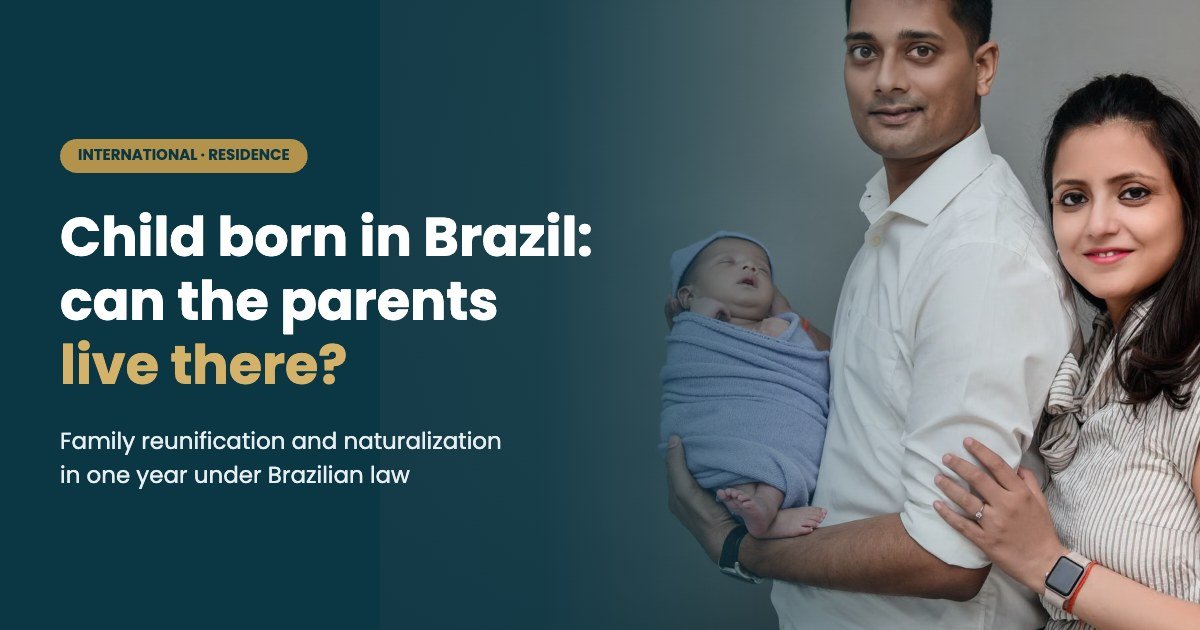
Foreign parents of a child born in Brazil often hear that the baby "guarantees" the family's right to stay in the country. The idea has a legal basis, but it is not automatic: the child is Brazilian from birth, and the parents must apply for a residence authorization.
This guide explains what Brazil's Constitution and Migration Law say, how a Brazilian child opens the way to the parents' residence and why the child also shortens the path to naturalization.
A child born in Brazil is Brazilian
Under Brazil's Constitution, anyone born on Brazilian soil is a native-born Brazilian, even if both parents are foreigners. The only exception is a child of foreign parents who are in Brazil serving their own country, such as diplomats. Registering the birth at a Brazilian registry office is enough for the child to have all the rights of any Brazilian.
The nationality, however, belongs to the child. The parents remain foreigners and must regularize their own immigration status.
A Brazilian child gives the parents the right to apply for residence
Brazil's Migration Law (Law 13,445/2017) provides for residence authorization for family reunification. The father or mother of a Brazilian child is among those who may apply. So are the spouse or partner of a Brazilian, the grandparents, grandchildren and siblings of a Brazilian, and anyone who has a Brazilian under their guardianship or custody.
In practice, the foreign parent submits the application to the federal immigration authorities with the child's birth certificate, a travel document and the other required documents. Once authorized, the immigrant registers and receives the National Migration Registration Card (CRNM), the identity document for foreign residents.
Documents usually required
- The child's Brazilian birth certificate
- A valid passport or other travel document
- Criminal record certificates from Brazil and the country of origin, usually legalized or apostilled and translated
- Proof of address in Brazil
- Proof of payment of the fees
The exact list depends on the case and on the rules in force on the date of the application. Foreign documents without an apostille or a certified translation are the most common cause of requests for more information and delays.
Naturalization in one year
Having a Brazilian child also shortens the path to Brazilian citizenship. For ordinary naturalization, the rule is at least four years of residence in Brazil, plus legal capacity, the ability to communicate in Portuguese and no criminal conviction. The Migration Law reduces this period to at least one year for those who have a Brazilian child, and also for those with a Brazilian spouse or partner.
Naturalization is optional. Many parents prefer to keep only the residence, and the choice depends on factors such as whether their country of origin allows dual citizenship.
Situations that require attention
- Parents who entered as tourists and overstayed
- A child registered by only one parent
- Separated parents, when one of them is not involved in the child's life
- A criminal record in Brazil or abroad
- A previous application that was denied or closed
In these cases, a prior review helps avoid denials and having to start over.
Frequently asked questions
Does a child born in Brazil make the parents Brazilian?
No. The child is a native-born Brazilian. The parents can apply for residence and, after one year of residence, for naturalization.
Can grandparents also live in Brazil because of a Brazilian grandchild?
The Migration Law includes ascendants of a Brazilian among those who may apply for residence for family reunification. Each application is assessed with the documents of the case.
Can I work in Brazil with residence for family reunification?
Yes. An immigrant with residence authorization can work and carry out the activities allowed to residents, subject to the rules of each profession.
I am outside Brazil. Can I start the process from abroad?
In many cases, yes, with a family reunification visa requested at a Brazilian consulate. The best route depends on where the family is and each person's situation.
If you are a foreigner with a Brazilian child and want to obtain residence or Brazilian citizenship, SPD's team can handle the application from start to finish, including for families who are still outside Brazil. See our residence and naturalization page and fill in the form, or message us on WhatsApp (62) 98184-3257 or (61) 99833-1103.
Official sources
- Brazilian Federal Constitution, art. 12, I, a (in Portuguese)
- Brazilian Migration Law (Law 13,445/2017), arts. 30, 37, 65 and 66 (in Portuguese)
By Sidnei Pedro Dias, attorney, OAB/GO 48.603, OAB/DF 68.207 and OAB/SP 501.693.
Read also
 Is a divorce granted abroad valid in Brazil? When the registry office is enough and when the STJ is needed
 Living abroad? How to sign a power of attorney for Brazil without traveling
 Cosmetic procedure went wrong in Brazil: what are the patient's rights?